
Predict material performance
before fabrication.
PAaaS helps battery and energy-material R&D teams make build, test, and lifecycle decisions under declared operating conditions.
§ 01 / What you receive
GS-2026 / SECT_01
What a customer receives
Bulk, surface, and interfacial behaviour of the material, modelled at atomic scale before any sample is fabricated.
Stability and failure thresholds across the thermal, mechanical, and coulombic conditions the system has to survive.
Degradation pathway and longevity bounds, with assumptions and uncertainty stated in plain terms.
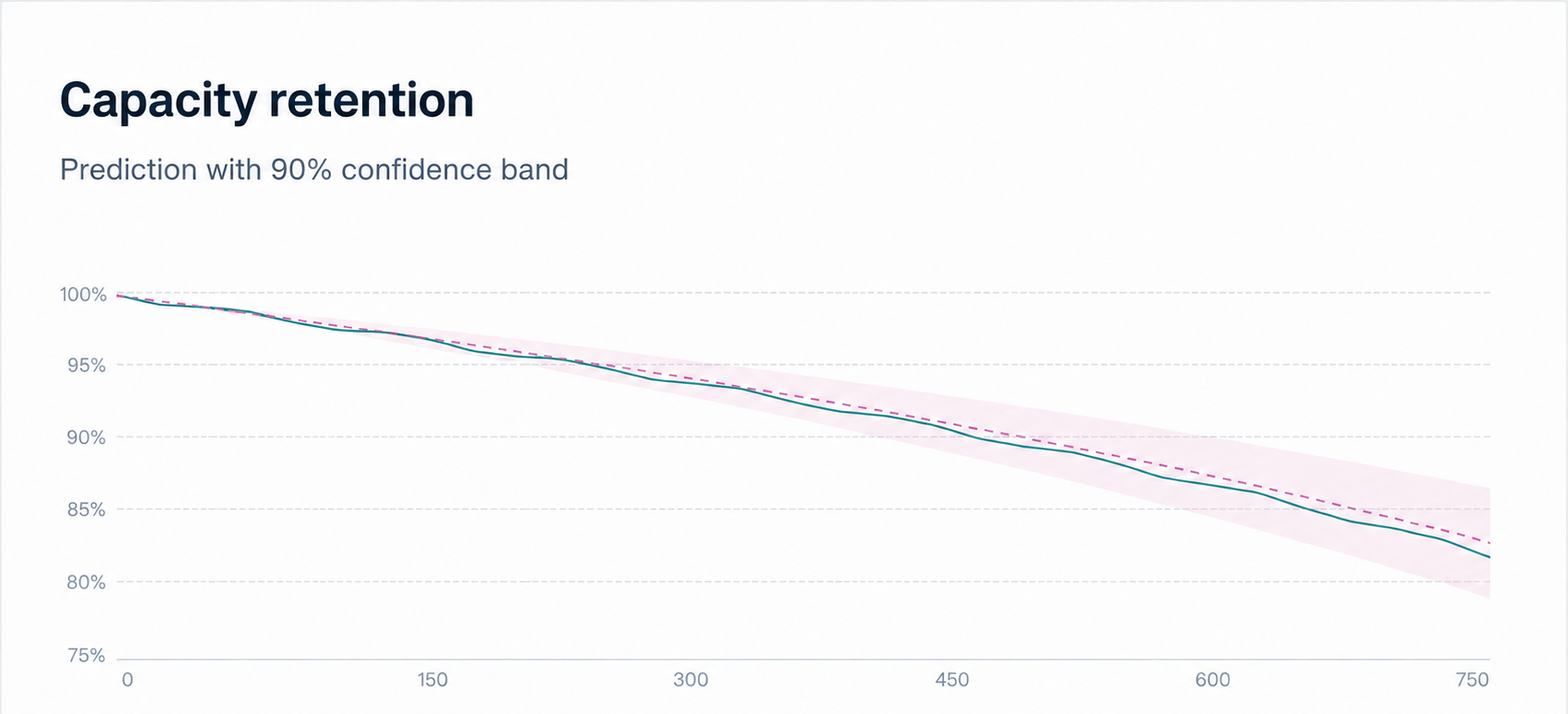
Battery Life Cycle Prediction is live.
The first capability in operational service is bounded to one application: predicting how a battery system degrades under realistic operating conditions, and when relevant performance thresholds may be crossed. Properties supply the underlying behaviour, the operating envelope defines the regime, and the lifecycle estimate is the integrated output.
Sim-B programme · declared assumptions · validation conditions
§ 03 / Engagement workflow
GS-2026 / SECT_03
How an engagement begins.
Three stages from first contact to a documented first cycle.
- 01
Submit a technical brief
Problem statement, material or system context, operating regime, timeline, and any existing validation data.
- 02
Alignment and data review
Technical-fit and scope review under the alignment filter; outcome typically within ten working days.
- 03
First prediction cycle
Workspace provisioning, methodology orientation, and a documented first cycle with defined success criteria.
§ 04 / Availability
GS-2026 / SECT_04
What a partner can access today.
Applications
- F.01Live
Battery Life Cycle Prediction
Sim-B / QMS-B
- F.02Forming
Superconductors Stability
RTS-W
- F.03Forming
Generation-side Materials
QMS-G
Platform surfaces
- SF.01Live
Console
grunuss.cloud
- SF.02Planned
Reports
Prediction content
- SF.03Planned
API
Programmatic access
- SF.04Planned
Repository
Reproducibility artefacts
The wider programme sequence is described in the institutional roadmap.
From run configuration to artefact retrieval.
Teams work in an authenticated console: configure a programme and its inputs, inspect each run as it progresses, and retrieve the resulting artefacts from one workspace.
§ 06 / Comparative analysis
GS-2026 / SECT_06
Where PAaaS differs.
PAaaS is designed to help teams decide what merits fabrication, then document how the prediction performs against observed behaviour. It complements laboratory testing and specialist simulation.
- P.01Build → test → decideEmpirical development
Fabricate a candidate, characterise it, then accept or reject it.
Most confidence is earned after physical work has begun.
- P.02Model a bounded questionSpecialist simulation
Use a defined model to examine a specific behaviour or operating case.
The result depends on method, input assumptions, and validation context.
- P.03Predict → validate → fabricatePAaaS
Predict properties, operating envelope, and lifecycle before fabrication.
Every result carries declared assumptions, uncertainty bounds, and validation conditions.
Boundary
PAaaS models physical behaviour under declared operating conditions. It does not forecast market outcomes or provide an unconditional performance commitment.
Begin a technical engagement.
Qualified industrial and institutional partners are invited to bring a problem statement, material or system context, operating regime, and any existing validation data.